
Generative Engine Optimization: The 2026 Guide to Getting Cited by AI Search

Table of Contents +
- What is generative engine optimization?
- How is GEO different from SEO?
- How do AI engines pick which sources to cite?
- What content types get cited most?
- What are the three levers that actually move citations?
- Which AI platform needs what? A quick map
- How do you build GEO at scale?
- Is AI search traffic even worth it?
- References
Generative engine optimization 2026 guide: get cited by AI search. GEO lifts AI visibility up to 40% and AI traffic converts at 3.76%.
TL;DR: Generative engine optimization (GEO) gets your content cited inside AI answers from ChatGPT, Perplexity, and Google AI Overviews. AI Overviews now appear in roughly 45% of searches and cut clicks by up to 58%. Citing sources lifts visibility 40%, statistics 37%. AI traffic converts at 3.76% versus 1.19% for organic. Being cited is the new ranking.
For two decades, the goal was a top-10 link. That game is ending. AI Overviews already show up in about 45% of Google searches and can pull up to 58% of clicks away from the results below them.[1] Gartner expects traditional search volume to drop 25% by 2026, and roughly 93% of Google AI Mode sessions already end without a click.[2] The new prize is not the blue link. It is the citation inside the answer.
This is the hub guide for everything we publish on AI search visibility. It covers what GEO is, how AI engines pick sources, what gets cited, and how to build it at scale. Each section links to a deeper guide on a single piece. Read this first, then go as deep as you need.
What is generative engine optimization?
Generative engine optimization is the practice of structuring and writing content so AI answer engines cite it as a source. Instead of ranking a page for a click, you make your page the material the model pulls into its generated answer. A controlled study from Princeton and Georgia Tech showed that GEO methods can raise a page's visibility in AI answers by up to 40%, with low-ranking pages gaining as much as 115%.[3]
You will see it called AEO (answer engine optimization), LLMO, or AI SEO. The mechanics are the same: earn the citation. For the full primer on the discipline, see our complete guide to AI SEO content.
GetTraffic writes and publishes SEO content automatically - articles that build authority and drive organic traffic - start your free trial.
How is GEO different from SEO?
SEO competes for a ranked position so a human clicks through. GEO competes to be quoted inside an answer so the human may never click at all. SEO rewards backlinks, keywords, and rank. GEO rewards clear structure, cited facts, and brand presence across the web. They overlap heavily - about 50% of AI-cited sources also rank in Google's top 10 - but the optimization targets differ.[4]
The biggest practical difference: in SEO, keyword stuffing once helped. In GEO it hurts. The Princeton study found stuffing keywords actually cut AI visibility by about 10%.[3] We break the full comparison down in GEO vs SEO.
How do AI engines pick which sources to cite?
AI engines retrieve a set of candidate pages, then cite only the few that best support the answer. ChatGPT Search, for example, retrieves many pages but cites only about 15% of them.[5] Selection favors pages that are easy to extract from, backed by data, and from domains the model already trusts. BrightEdge found domains with a Domain Rating under 30 are rarely cited at all.[4]
One signal stands out. Brand mentions across the web correlate 0.664 with citation probability - the strongest off-site factor measured.[4] If the model has seen your brand named often, it is far more likely to quote you. If your content never gets cited, our guide on why AI isn't citing your content walks through the common blockers.
What content types get cited most?
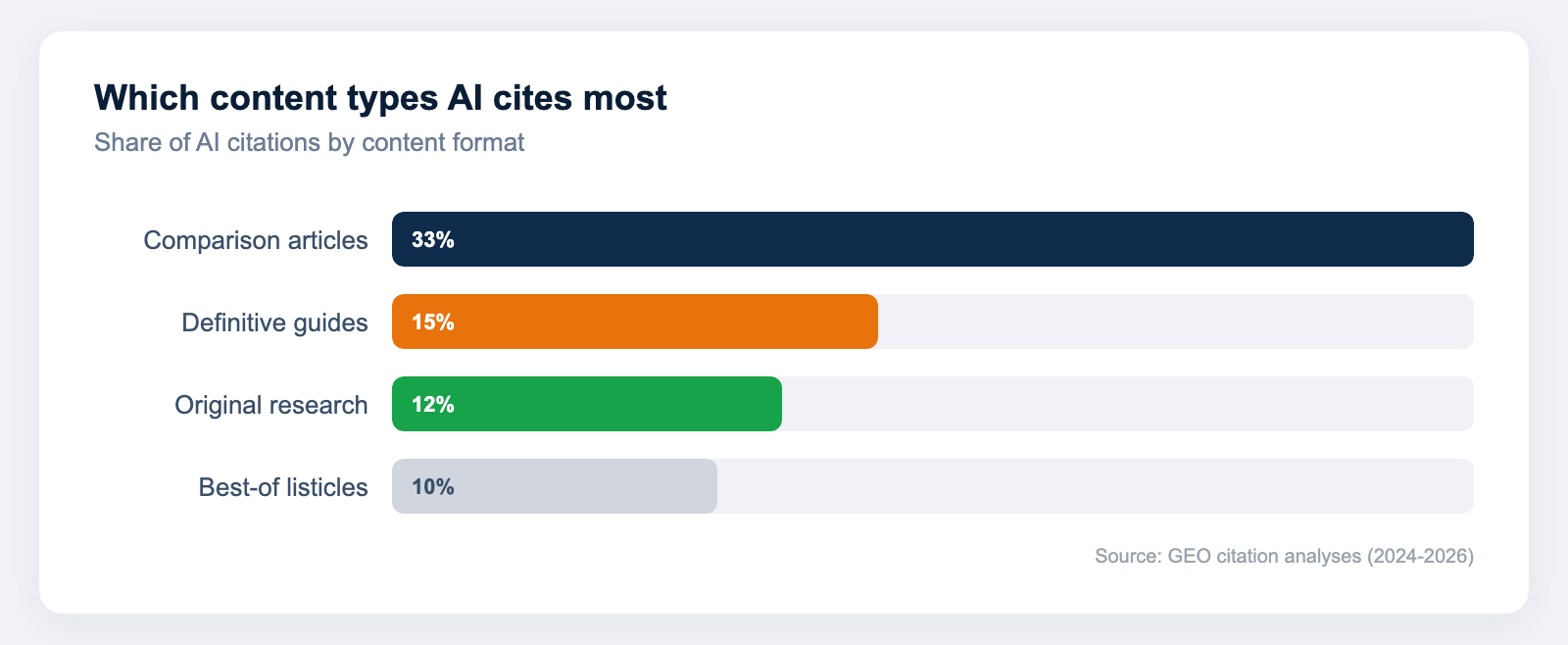
Not all formats earn citations equally. Comparison content wins by a wide margin, followed by definitive guides and original research. Listicles trail. The pattern is clear: AI engines favor content that resolves a decision or supplies hard data. Optimized content is cited roughly three times more often than unoptimized content covering the same topic.[3]
| Content type | Share of AI citations |
|---|---|
| Comparison content | ~33% |
| Definitive guides | ~15% |
| Original research | ~12% |
| Listicles | ~10% |
This is why we publish comparison assets like GetTraffic vs other AI SEO tools alongside deep guides. Comparison plus data is the format AI engines reach for first.
What are the three levers that actually move citations?
Three levers move the needle: structure, authority, and presence. Structure makes your facts easy to extract. Authority makes the model trust them. Presence makes your brand familiar enough to surface. Most teams over-invest in one and ignore the other two. The wins come from pulling all three.
1. Structure - make extraction easy
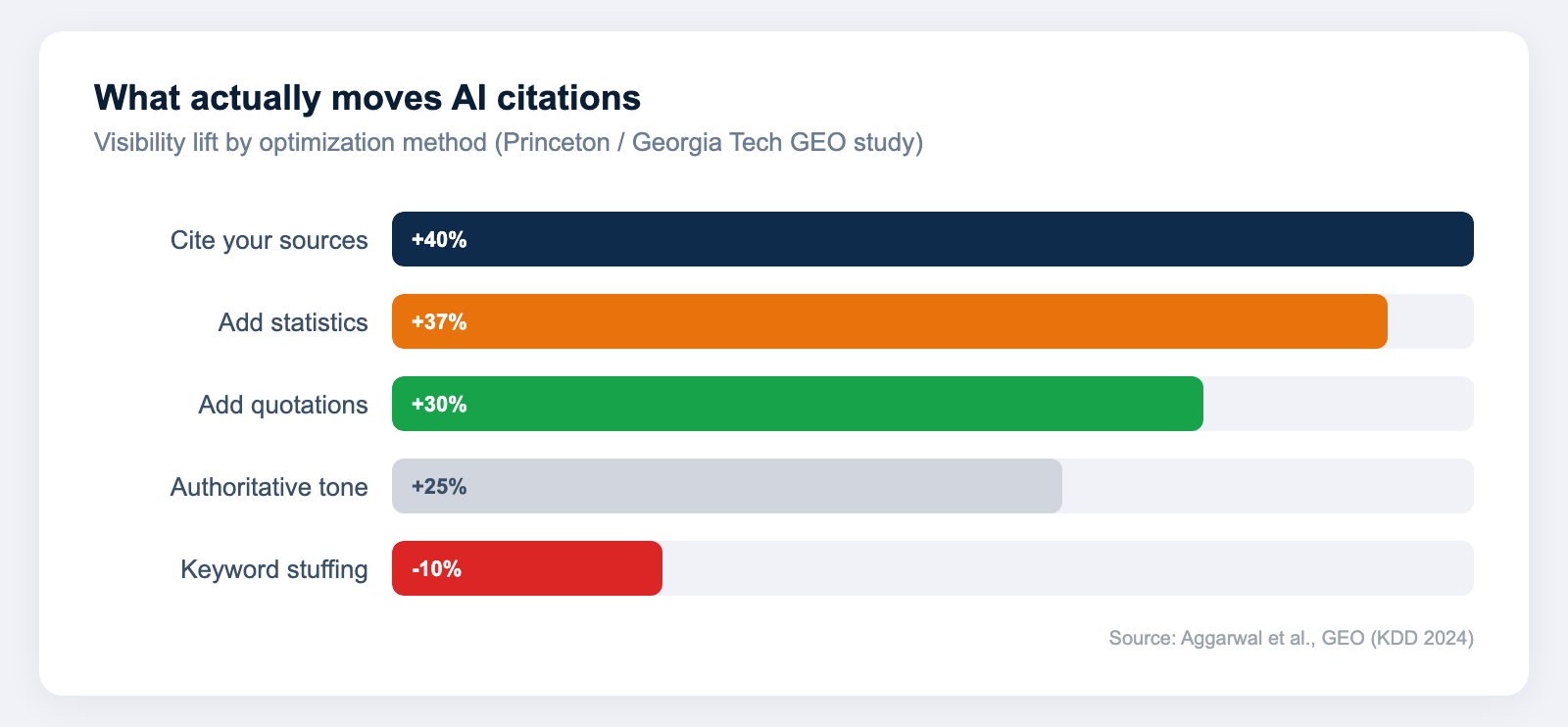
Lead every section with a direct answer of 40 to 80 words. Use clear headings, tables, and lists. Cite sources and add statistics inside the text. The Princeton study quantified each move: citing sources lifted AI visibility 40%, adding statistics 37%, and including quotations 30%.[3]
| Optimization | Visibility change in AI answers |
|---|---|
| Cite authoritative sources | +40% |
| Add statistics | +37% |
| Add quotations | +30% |
| Keyword stuffing | -10% |
2. Authority - earn trust
Domain Rating still matters. Sites under DR 30 rarely get cited, and half of AI-cited pages also rank top 10 in Google.[4] Authority is built by covering a topic completely, not by chasing one keyword. That is the job of a topical-authority cluster - see how topical authority clusters work.
3. Presence - get mentioned
Brand mentions are the strongest off-site citation signal at 0.664 correlation.[4] The more places name your brand, the more the model trusts you as a source. Presence compounds with every article, review, and mention.
SEO content that ranks, written and published for you
GetTraffic creates authority-building content clusters for your business. No writing, no freelancers, no content calendar. Agency-quality results at 91% less cost.
Start My Free TrialWhich AI platform needs what? A quick map
Each engine retrieves and cites differently, and each runs its own crawler. Block the crawler and you cannot be cited - full stop. Google AI Overviews lean on pages that already rank. ChatGPT Search runs on the Bing index and cites about 15% of retrieved pages. Perplexity rewards a tight answer capsule and schema. Here is the practical map.
| Engine | Index / source | Crawler to allow | What wins |
|---|---|---|---|
| Google AI Overviews | Google index | Google-Extended | Top-10 rank, clear answers |
| ChatGPT Search | Bing index | OAI-SearchBot, GPTBot | Bing visibility, extractable facts |
| Perplexity | Own + web | PerplexityBot | 40-80 word capsule, schema |
| Claude | Web | ClaudeBot, anthropic-ai | Authoritative, cited sources |
Each platform has its own crawler, and blocking it prevents citation entirely.[6] Go deeper per engine: rank in Google AI Overviews, get cited by ChatGPT, and optimize content for Perplexity.
The answer-capsule rule
Perplexity favors a 40 to 80 word answer capsule placed right under the heading. Adding schema raised content selection by about 73%, and cited content carried roughly 32% more concepts than uncited content.[6] ChatGPT Search, built on Bing, needs OAI-SearchBot and GPTBot allowed before it can see you at all.[5]
Does llms.txt help?
The llms.txt file is a proposed standard for guiding AI crawlers to your key content. Adoption is early and support is uneven. We tested whether it actually changes citation rates in does llms.txt work - read that before you spend time on it.
How do you build GEO at scale?
Doing GEO once is easy. Doing it across hundreds of topics is the hard part. Every page needs a direct answer capsule, embedded statistics, cited sources, schema, and a place inside a topical cluster that builds authority. Hand-writing that for one article takes hours. For a full cluster it takes months, which is why most teams never finish.
This is the gap an engine closes. GetTraffic builds industry-specific topical-authority clusters and publishes them straight to your CMS - Shopify, WooCommerce, WordPress, Webflow, Wix, Framer, or API. The structure, statistics, and internal links that GEO rewards are built in, so you cover a topic completely without writing each piece by hand. One plan, 10 articles a month, 7-day trial.
- Pick a topic cluster your buyers actually search.
- Write or generate each page with a 40-80 word answer capsule up top.
- Embed statistics, citations, and quotations - the three moves worth +40%, +37%, +30%.[3]
- Add schema and internal links across the cluster.
- Allow every AI crawler in robots.txt.
- Track citations per platform and iterate.
On measurement, see how to measure AI search visibility so you know what is working.
Is AI search traffic even worth it?
Yes, and the conversion data is the reason. AI search traffic converts at 3.76% versus 1.19% for traditional organic - a 216% lift, per Amsive analysis. The Washington Post reported AI-referred visitors subscribed at four to five times the rate of other traffic.[7] The visitor arrives already informed by the answer, so intent is higher.
The volume may be smaller today, but the quality is far higher, and the volume is climbing fast as click-through to traditional results falls.[2] We dig into the numbers in does AI search traffic convert. For a time-poor founder, the math favors getting cited now while competition is light.
References
- Search Engine Land (2025). How to optimize for AI Overviews. searchengineland.com
- Omnia (2025). AI search monitoring tools. useomnia.com
- Aggarwal et al. (2024). GEO: Generative Engine Optimization (Princeton / Georgia Tech). arxiv.org
- WordStream (2025). How to get cited by AI search. wordstream.com
- Erlin (2025). ChatGPT Search optimization. erlin.ai
- Ziptie (2025). How to optimize content for Perplexity AI. ziptie.dev
- Search Engine Land (2025). The SEO-GEO gap: AI search traffic vs organic traffic. searchengineland.com
Frequently Asked Questions
What is generative engine optimization (GEO)?
How is GEO different from traditional SEO?
What content gets cited most by AI search engines?
Does AI search traffic actually convert?
How do AI engines decide which sources to cite?
Do I need to allow AI crawlers to get cited?
Get your business on page 1 of Google
Get your business found on Google - SEO content written and published automatically.
Start My Free Trial7-day free trial