How to Rank in Google AI Overviews (2026)


Table of Contents +
Rank in Google AI Overviews in 2026: top-10 rankings, 134-167 word passages, FAQ schema, and topical authority. The 9-step, data-backed checklist.
TL;DR: Google AI Overviews now appear in roughly 45% of searches and cut clicks by up to 58%. To get cited, rank in the top 10, write 134-167 word answer passages, score high on semantic completeness, add citations and statistics, use FAQPage schema, and build topical authority across content clusters.
AI Overviews changed what ranking means. A user types a question, Google generates an answer at the top of the page, and your link sits inside that answer as a cited source - or it does not appear at all. The traffic that used to flow from a blue link now depends on whether the model picks your content to summarize. For DACH e-commerce teams that already fight for organic visibility, this shifts the target: you are no longer optimizing only for a click, you are optimizing to be the source the model trusts enough to quote.
The good news: the signals that earn an AI Overview citation are concrete and measurable. None of them require guesswork. This guide breaks down what works, with the numbers behind each decision, and ends with a nine-step checklist you can run against any page. For the broader picture across every AI engine - ChatGPT, Perplexity, Gemini, and Google's own AIO - see our generative engine optimization guide.
What are Google AI Overviews?
AI Overviews are AI-generated answer boxes that sit above the organic results for many queries. Google reads multiple ranking pages, synthesizes an answer, and cites a handful of sources with links. They now show up in around 45% of searches and can cut clicks to the underlying pages by up to 58%.[1]
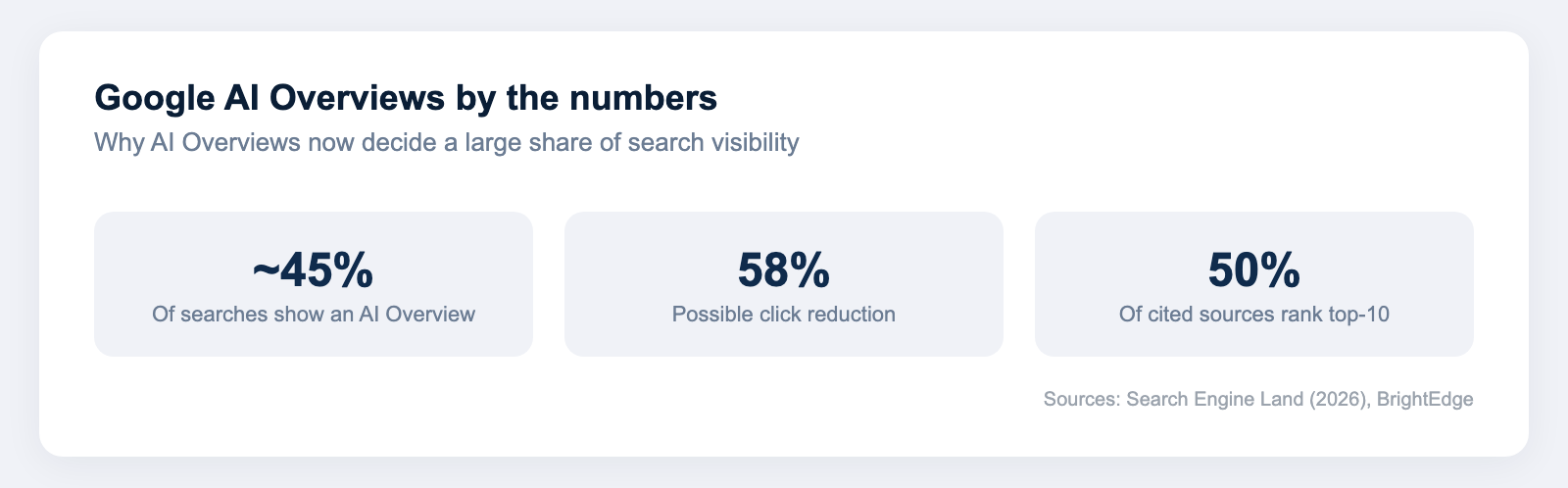
That cut in clicks is the part that worries marketers, and it should. When the answer is rendered in full at the top of the page, many users never scroll. But the same box also creates a new prize. If your page is one of the cited sources, you earn a high-visibility placement above every blue link, plus the implicit endorsement of being the source Google chose. The work below is about being that source rather than the page nobody clicks.
GetTraffic writes and publishes SEO content automatically - articles that build authority and drive organic traffic - start your free trial.
Do I need to rank top-10 to appear?
Effectively, yes. Around 50% of sources cited in AI Overviews already rank in the organic top 10, and the top-10 position correlates strongly with being selected as an AIO source.[1][2] Domain strength matters too: pages on domains with a Domain Rating under 30 are rarely cited.[2]
So classic SEO is not dead. It is the entry ticket. If you do not rank, you do not get summarized. The sequence matters: build the rankings first with solid on-page work and links, then optimize the passages the model extracts. Teams that skip the ranking step and jump straight to AIO formatting tricks see no movement, because the model never considers their page in the first place. Earn the top-10 position, then make your content the easiest part of that top 10 to quote.
How long should answer passages be?
Short and complete wins. AI Overviews favor passages of 134-167 words when extracting answers, and 62% of featured content sits in the 100-300 word range.[3] The pattern is clear: answer the question directly in the first two sentences, then add the supporting detail in the same block.
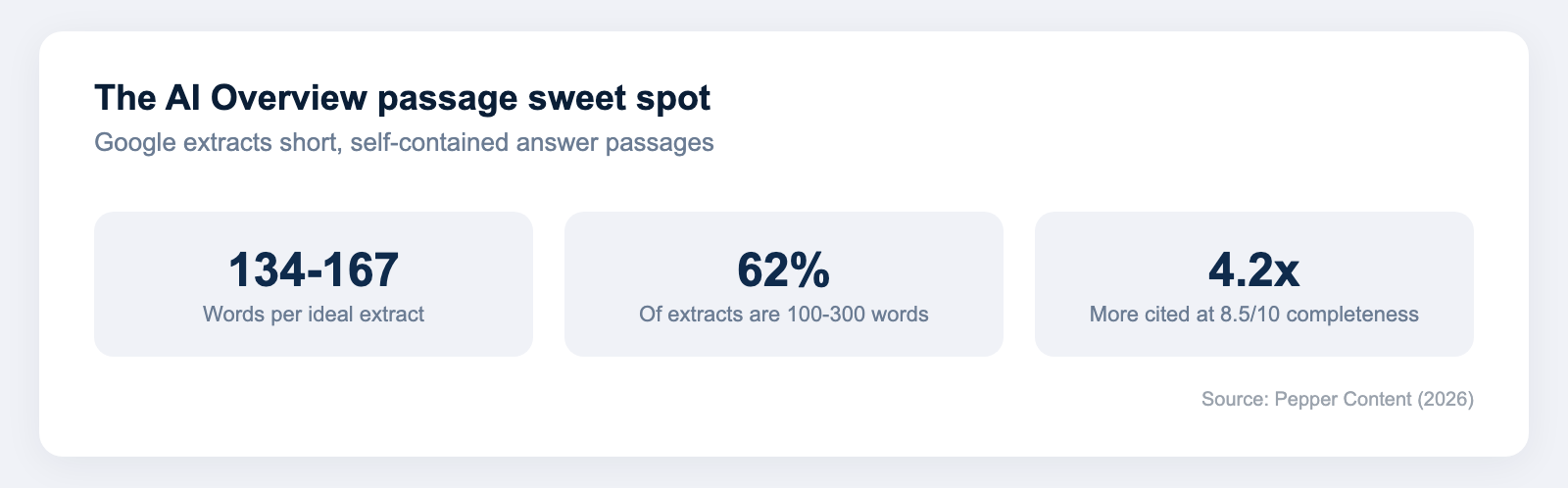
This has a practical consequence for how you structure a page. Instead of one long flowing essay, build it as a series of self-contained answer blocks, each opening with the question as a heading and the answer in the first lines. The model can lift any one of those blocks cleanly without needing the surrounding text. Walls of text that bury the answer in paragraph four rarely get extracted, because the model cannot isolate a clean, complete passage.
| Signal | Target | Why it matters |
|---|---|---|
| Extract passage length | 134-167 words | Matches the range AIO pulls most often |
| Featured block range | 100-300 words | 62% of cited content falls here |
| Semantic completeness score | 8.5/10 or higher | ~4.2x more likely to be cited |
| Answer placement | First 2 sentences | Models extract the lead, not the conclusion |
How does Google pick AIO sources?
Two things drive selection: semantic completeness and trust signals. Content scoring 8.5 out of 10 or higher on semantic completeness is roughly 4.2x more likely to be cited.[3] Completeness means you cover the question and its obvious follow-ups in one place, so the model does not need a second source. If someone asks how long an AIO passage should be, the complete answer also explains why, how to structure it, and what happens if you ignore the range. Each follow-up you resolve on the page is a reason for the model to stay with your content instead of stitching together two competitors.
Beyond completeness, content engineering matters. A Princeton study found that adding cited sources lifted visibility in generative answers by 40%, adding statistics by 37%, and adding quotations by 30%, while keyword stuffing dropped it by 10%.[4] Those are large, repeatable gains from edits any writer can make in an afternoon. Demonstrating real experience and expertise - the E-E-A-T signals - reinforces the same trust the model looks for: a named author with a credible bio, original data, and first-hand examples all tell the model this source is worth quoting.
The lesson is concrete: cite your facts, quantify your claims, attribute quotes, and never pad with keywords. Every unsupported sentence is a sentence the model has no reason to trust over a competitor's. The same approach travels across engines - it gets you cited by ChatGPT and helps you optimize content for Perplexity, because they all reward the same underlying signal: verifiable, complete answers.
Does topical authority help?
Yes, and it compounds. AI engines reward sites that cover a subject deeply, not just one strong page. Brand mentions correlate with citation probability at 0.664, one of the strongest single signals measured.[2] The way to build that breadth is topical authority clusters: a pillar page plus a dense web of supporting articles that interlink.
This is the structural play behind AIO visibility. When you cover every angle of a topic, you rank for more queries, get cited across more answer boxes, and accumulate the brand mentions that lift citation odds. A single strong article competes for one or two AIO placements. A complete cluster of fifteen interlinked articles competes for dozens, and each new piece strengthens the rest through internal links and shared authority.
The catch is volume. Earning citations across a whole cluster means publishing consistently, keeping every page complete, and refreshing the data on schedule. GetTraffic builds industry-specific topical-authority clusters and auto-publishes them to your CMS, which is the systematic way to earn citations across many keywords instead of one page at a time. For the full method, read our complete AI SEO content guide.
SEO content that ranks, written and published for you
GetTraffic creates authority-building content clusters for your business. No writing, no freelancers, no content calendar. Agency-quality results at 91% less cost.
Start My Free TrialHow do I keep AIO citations fresh?
Treat citations as perishable. AI Overviews regenerate constantly, and the source set shifts as content ages, competitors publish, and queries evolve. Pages with current dates, updated statistics, and recent examples hold their place better than stale evergreen posts. A page that earned a citation in January can quietly lose it by June if a competitor publishes fresher numbers on the same question. Re-audit your top cited pages quarterly and refresh the data points the model is pulling.
Practically: update publish dates when you make real changes, replace statistics older than two years, and add new sections when a query develops new sub-questions. The Princeton findings hold here too - refreshed citations and statistics are exactly the signals that lift generative visibility.[4] Set a recurring quarterly review of your ten most-cited pages, check what the current AI Overview pulls for each target query, and patch any gap a competitor has opened. The cost of this maintenance is small next to the cost of silently dropping out of a high-traffic answer box.
Does FAQPage schema matter for AIO?
It does. FAQPage schema sits among the highest AI citation rates because it maps question to answer in a structure models parse cleanly.[5] One caveat: the on-page text must match the schema exactly. A mismatch between your markup and your visible content reads as manipulation and can hurt you.[5]
Add FAQPage markup to pages that answer clear questions, mirror the exact wording on the page, and keep each answer self-contained in 40-75 words. Pull the questions straight from real search queries and the People also ask box, because those are the phrasings the model is matching against. Structured data does not force a citation, but it makes your content trivially easy for the model to parse, which is half the battle when several top-10 pages are competing for the same slot.
What is the AI Overviews optimization checklist?
Work through this in order. Each item maps to a measured signal, not a guess. Start with rankings, then structure, then trust, then maintenance. Skipping ahead does not work: a perfectly formatted page that ranks on position 30 still gets ignored, and a top-ranking page with no statistics or schema leaves easy citation gains on the table. Treat the steps as a sequence, not a menu.
| Step | Action | Backed by |
|---|---|---|
| 1 | Rank in the organic top 10 for the target query | ~50% of AIO sources rank top 10 |
| 2 | Build Domain Rating above 30 before chasing citations | DR under 30 rarely cited |
| 3 | Lead each section with a 40-75 word direct answer | Models extract the lead passage |
| 4 | Keep core answer passages at 134-167 words | Preferred AIO extract length |
| 5 | Cover the question plus follow-ups (8.5+/10 completeness) | ~4.2x more likely to be cited |
| 6 | Add cited sources, statistics, and quotations | +40%, +37%, +30% visibility |
| 7 | Add FAQPage schema that matches on-page text exactly | Highest citation rate; mismatch penalized |
| 8 | Build topical authority clusters around the pillar | Brand mentions correlate 0.664 with citation |
| 9 | Refresh statistics and dates quarterly | Citations are perishable |
Doing this once per article is slow but manageable. Doing it across a full cluster, every month, while keeping older pages refreshed, is where most lean teams run out of time. That is the real constraint - not knowing what to do, but having the hours to do it at scale. GetTraffic runs the cluster strategy and publishing on a single plan at EUR 249 per month for ten articles, which keeps the structural work moving without an agency budget, with a 7-day trial to test it against your own niche. See the details on our pricing page.
References
- Search Engine Land. How to Optimize for AI Overviews. searchengineland.com
- WordStream. How to Get Cited by AI Search. wordstream.com
- Pepper Content. How to Rank in Google AI Overviews: The 2026 Playbook. pepper.inc
- Aggarwal et al. (2023). GEO: Generative Engine Optimization. arxiv.org
- WordStream. How to Get Cited by AI Search. wordstream.com
Frequently Asked Questions
Do I need to rank in the top 10 to appear in AI Overviews?
How long should an AI Overviews answer passage be?
What makes Google pick a page as an AI Overview source?
Does FAQPage schema help with AI Overviews?
Does topical authority help you rank in AI Overviews?
How do I keep my AI Overview citations fresh?
Get your business on page 1 of Google
Get your business found on Google - SEO content written and published automatically.
Start My Free Trial7-day free trial