
How to Measure AI Search Visibility (Tools + Free DIY Method)


Table of Contents +
Track AI search visibility with 4 metrics: citation rate, share of voice, sentiment, conversion. Compare 6 tools or use a free 20-query monthly method.
TL;DR: To track AI search visibility, monitor four metrics: citation rate, share of AI voice, sentiment, and conversion attribution. Use a tool like Otterly, Peec AI, Profound, ZipTie, or Semrush, or run a free 20-query monthly check across ChatGPT, Perplexity, and Google AI Mode and log who gets cited.
You cannot improve what you do not measure. AI answer engines now sit between your content and your buyers, and most of them never send a click. Roughly 93% of Google AI Mode sessions end without anyone visiting a website.[1] Your rank tracker does not see any of that. A page can be quoted word for word inside an answer and your analytics will show nothing.
That gap is widening. Gartner expects traditional search volume to drop 25% by 2026 as buyers shift to AI assistants.[1] So the question is no longer whether you rank for a keyword. It is whether ChatGPT, Perplexity, Gemini, and Copilot name you when a buyer asks. For a time-poor founder or marketing manager, that shift is awkward: the dashboards you already pay for tell you nothing about it. Here is how to measure that, with tools or for free, without adding hours to your week.
Why measure AI search visibility?
Because rank trackers are blind to it. AI answers are mostly zero-click, so a page can be cited heavily and still show zero referral traffic in your reports. With AI Mode sessions running about 93% zero-click,[1] visibility now means citations and brand mentions inside answers, not blue-link positions. Measuring it is the only way to know if your content is working.
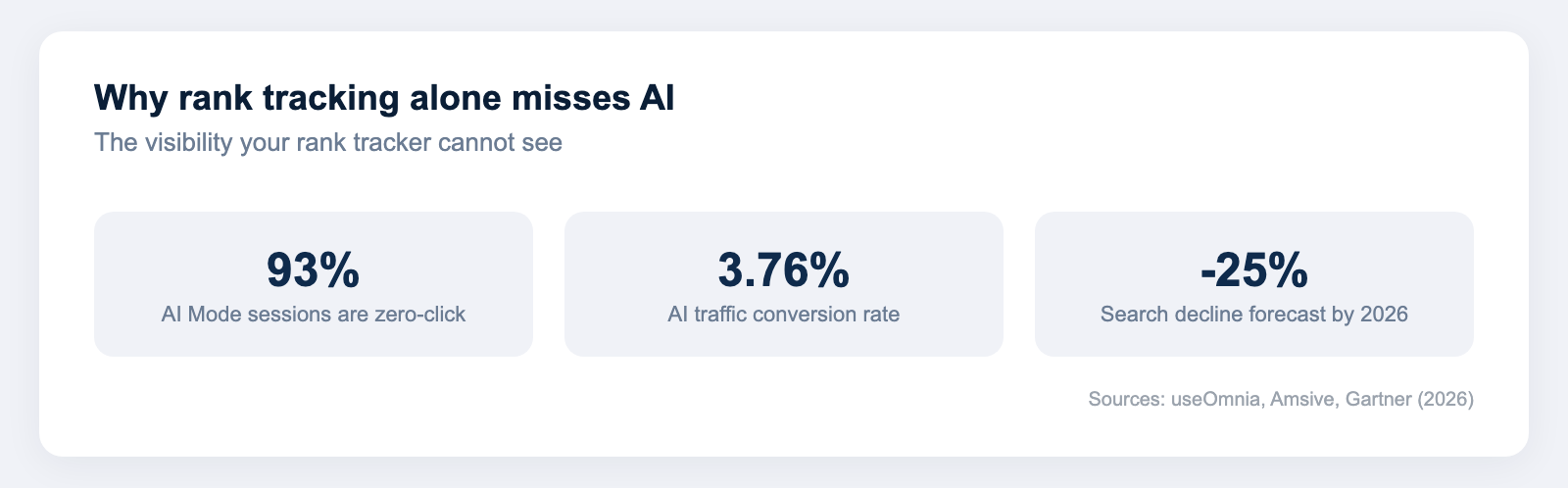
There is also a revenue reason. AI-referred visitors convert at 3.76% versus 1.19% for traditional organic, a 216% lift.[2] These are smaller numbers of higher-intent buyers. By the time someone clicks through from an AI answer, the assistant has already done the comparison work and the buyer is closer to a decision. If you ignore the channel, you miss your best-converting traffic and you have no idea which content earns it.
Finally, measurement protects you from spending blind. AI search content is a moving target, and without numbers you cannot tell whether last quarter's work paid off or whether a competitor quietly took your spot in the answers. A baseline turns guesswork into decisions. For the full strategy behind earning these citations, see our generative engine optimization guide.
GetTraffic writes and publishes SEO content automatically - articles that build authority and drive organic traffic - start your free trial.
What metrics actually matter?
Four metrics tell you everything you need. Citation rate: how often you are named or linked in answers. Share of AI voice: your citations versus competitors for the same prompts. Sentiment: whether the mention is positive, neutral, or negative. Conversion attribution: revenue from AI-referred sessions. Track these monthly and you have a complete picture.[1]
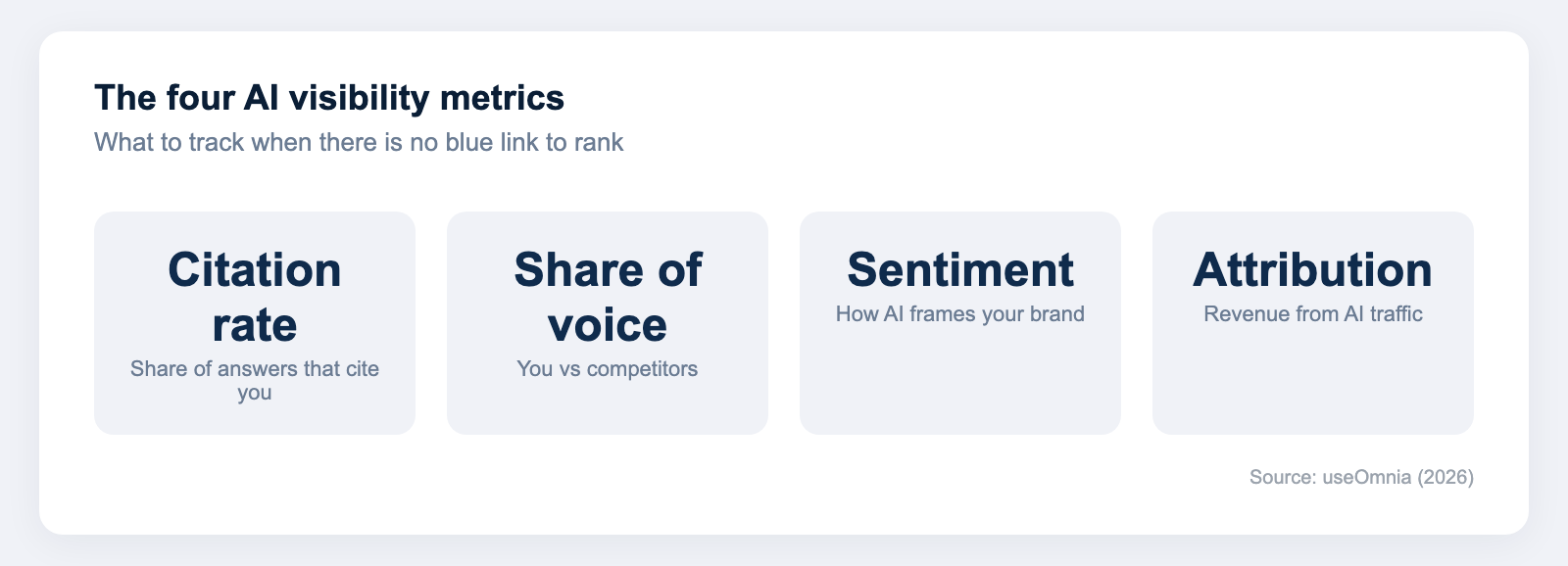
Brand mentions deserve special attention. The volume of brand mentions correlates 0.664 with citation probability, one of the strongest signals available.[3] In plain terms: the more often your brand is talked about across the web, the more likely an AI is to cite you. So tracking share of voice is not vanity. It predicts whether you get cited at all.
A word on sentiment, which is easy to skip. A citation is not automatically good. An assistant can name you while describing a weakness, a pricing complaint, or a comparison you lose. Logging whether each mention is positive, neutral, or negative stops you from celebrating a number that is actually working against you. Quality of mention matters as much as quantity, and only sentiment tracking surfaces the difference.
| Metric | What it answers | Why it matters |
|---|---|---|
| Citation rate | How often am I named or linked? | Direct visibility inside answers |
| Share of AI voice | How do I compare to competitors? | Competitive position per topic |
| Sentiment | Is the mention positive or negative? | Quality, not just quantity |
| Conversion attribution | Does AI traffic turn into revenue? | Ties visibility to the bottom line |
What is the free DIY method?
Pick 20 priority queries that matter to your business, run them across ChatGPT, Perplexity, and Google AI Mode once a month, and log who gets cited.[1] It costs nothing but an hour, and it gives you a real baseline before you pay for software. Use the same queries every month so your numbers are comparable.
Build your query list around buyer language: problems, comparisons, and category terms a customer would type. Then follow these steps:
- List 20 queries: a mix of "best [category]", "[problem] solution", and "[you] vs [competitor]".
- Run each query in ChatGPT, Perplexity, and Google AI Mode. Use a fresh or logged-out session to avoid personalization.
- For each answer, record: were you cited (yes/no), which competitors were cited, and is your mention positive, neutral, or negative.
- Calculate citation rate (your citations divided by total runs) and share of voice (your citations divided by all brand citations).
- Save the answer text. Wording changes month to month, and the changes tell you what content is moving.
- Repeat on the same date each month. Track the trend, not a single snapshot.
A simple spreadsheet with one row per query and one column per month is enough to start. The point is consistency, not polish. One caveat: AI answers are personalized and can vary by location and account history, so use logged-out sessions and accept that any single run is a sample, not a verdict. The trend across months is what you trust, not one good or bad day.
Twenty queries is a deliberate floor. Fewer and your numbers swing too much to read; many more and the manual work stops being sustainable for a small team. If you can only run the check quarterly at first, do that. A rough baseline beats no baseline, and you can tighten the cadence once you see the channel moving.
What tools automate this?
Several platforms run hundreds of prompts daily across ChatGPT, Perplexity, Gemini, Claude, and Copilot, then report citation rate, share of voice, sentiment, and competitor comparisons automatically.[1] They replace the manual logging once your query list outgrows a spreadsheet. Most start as monthly subscriptions and scale by prompt volume.
| Tool | Platforms covered | Best for |
|---|---|---|
| Otterly | ChatGPT, Perplexity, Google AI | Simple, fast first setup |
| Peec AI | ChatGPT, Perplexity, Gemini | Competitor share-of-voice tracking |
| Profound | ChatGPT, Perplexity, Copilot, Gemini | Enterprise depth and analytics |
| ZipTie | ChatGPT, Perplexity, Google AI | Page-level citation diagnostics |
| Semrush AI Toolkit | ChatGPT, Perplexity, Gemini, AI Overviews | Teams already on Semrush |
| SE Ranking | ChatGPT, Google AI Overviews | Budget-conscious agencies |
Pick by where you already work and how deep you need to go. If your team lives in Semrush, the AI Toolkit keeps everything in one place. If you want competitor share of voice front and center, Peec AI is built around it. If you need page-level diagnostics to see which URL earned a citation, ZipTie is strong there. Profound suits larger teams that want analytics depth and broad platform coverage, while Otterly and SE Ranking get you started without a heavy commitment.
Start free with the DIY method, then move to a tool when you have proof the channel matters. The metrics are the same either way. The tool just runs more prompts, more often, with less of your time. Do not buy software to discover whether AI search matters to you; buy it to scale a thing you have already confirmed works.
How do I attribute revenue to AI traffic?
Measure citations and conversions together. Citations tell you who sees you. Conversions tell you what that visibility is worth. Since AI referrals convert at 3.76% against 1.19% for organic,[2] even modest AI traffic can outperform a much larger organic channel on revenue. Attribution closes the loop between visibility and money.
Set it up in three moves. First, create a referral segment in GA4 for known AI sources (chatgpt.com, perplexity.ai, gemini.google.com, copilot.microsoft.com, and similar). Second, track conversions and conversion rate for that segment separately so the high intent does not get buried inside direct or organic. Third, cross-reference high-converting landing pages against the queries where you are cited. The overlap shows which cited content actually drives revenue, and that is the content to expand.
Expect attribution to be imperfect. Some AI tools strip referrer data, and a buyer who reads your name in an answer may search your brand and arrive as direct traffic instead. Watch for branded-search lift and direct-traffic growth alongside your citation rate. When citations rise and branded queries rise in the same period, the channel is working even if GA4 cannot draw a clean line. For a fuller breakdown, see whether AI search traffic converts.
SEO content that ranks, written and published for you
GetTraffic creates authority-building content clusters for your business. No writing, no freelancers, no content calendar. Agency-quality results at 91% less cost.
Start My Free TrialHow often should I check?
Monthly for most businesses. AI answers shift, but not so fast that weekly checks add signal over noise. A monthly cadence with the same 20 queries gives you a clean trend line and catches real movement. Move to weekly only during an active content push or after a major model update, when you expect rankings to change.
Whatever cadence you pick, hold it steady. Comparable data beats frequent data. The measurement only tells you what to build next: the topics where competitors get cited and you do not. That is where an engine like GetTraffic fits, turning those gaps into topical-authority content clusters that earn the citations you are tracking. Measure first, then build against the gaps.
How is this different from regular SEO measurement?
Traditional SEO measures positions and clicks. AI search measurement tracks citations, share of voice, and sentiment inside answers that mostly never produce a click. The metrics, tools, and cadence all differ. You are watching what AI says about you, not where a link sits on a results page. The two overlap but are not interchangeable.
If you want the strategic difference between the two disciplines rather than just the measurement, read GEO vs SEO. The short version: SEO earns the ranking signals that still feed AI models, while AI search measurement confirms whether that work is translating into citations and revenue. Run both.
References
- Omnia (2025). AI Search Monitoring Tools. useomnia.com
- Search Engine Land (2025). The SEO-GEO gap: AI search traffic vs organic traffic. searchengineland.com
- WordStream (2025). How to get cited by AI search. wordstream.com
Frequently Asked Questions
What metrics measure AI search visibility?
Can I track AI search visibility for free?
Which tools track AI search visibility?
How often should I check AI search visibility?
Why do rank trackers miss AI search visibility?
Does AI search traffic actually convert?
Get your business on page 1 of Google
Get your business found on Google - SEO content written and published automatically.
Start My Free Trial7-day free trial