
Does llms.txt Actually Work? What the Data Says (2026)

Table of Contents +
Does llms.txt work? In 2026, no major AI engine reads it for citations and 8 of 9 sites saw no traffic change. Here is what the data says - and what to do instead.
TL;DR: As of 2026, no major AI engine reads llms.txt for citations. Google has confirmed none of its Search systems touch the file. When Search Engine Land tested it, 8 of 9 sites saw no measurable traffic change. llms.txt is a real standard with a narrow developer-docs use case - but as a marketing-citation lever, it does nothing. Spend the effort on what moves the needle.
llms.txt has become one of those things every SEO blog tells you to add "before it's too late." The pitch is simple: drop a Markdown file at your root, and AI engines like ChatGPT, Perplexity, and Gemini will read it and cite you more. It sounds plausible. It echoes robots.txt and sitemap.xml, two files that actually do something. So thousands of marketers added it and waited for the citations to roll in.
They didn't. The honest version of this story is that llms.txt is a proposed convention nobody with a major crawler has agreed to follow. That's not a controversial opinion - it's what the platforms themselves say. Below is what the evidence actually shows, and where your time is better spent.
What is llms.txt?
llms.txt is a proposed standard: a Markdown file you place at your domain root (yoursite.com/llms.txt) that gives large language models a curated, clean summary of your most important pages. The idea is to spare an LLM from parsing messy HTML and point it straight at your best content. It is a community proposal, not an official spec from any AI company.
The format borrows its instinct from robots.txt and sitemap.xml. Those work because Google and Bing committed to honoring them. llms.txt has no such commitment behind it. That distinction - proposal versus honored standard - is the whole ballgame, and it's exactly the part the hype skips over.
GetTraffic writes and publishes SEO content automatically - articles that build authority and drive organic traffic - start your free trial.
Does any AI engine actually read it?
No. As of 2026, no major AI company - OpenAI, Google, Anthropic, Meta, or Mistral - commits to reading llms.txt in production for answering queries or selecting citations.[1] The engines that decide whether to cite you crawl and render your live pages the same way a search bot does. A separate Markdown file sits outside that pipeline.
This is the gap between intuition and reality. The file looks like infrastructure, so people assume it plugs into something. It doesn't. There is no production reader on the other end of the connection for the use case marketers care about.
What does Google say?
Google has been blunt. John Mueller confirmed in 2025 that none of Google's Search systems read or act on llms.txt.[1] That covers classic Search and AI Overviews, which draw from the same index. So if your goal is visibility in Google's AI answers, the file is doing nothing - Google has told you so directly.
When the company that runs the largest AI-answer surface on the web says its systems ignore a file, that's about as clear as platform signals get. There is no hidden reader, no quiet rollout. The plumbing simply isn't connected.
Did sites that added it see results?
Largely no. Search Engine Land ran a controlled look at sites that deployed llms.txt and found 8 of 9 saw no measurable traffic change.[1] That is a near-total null result. The honest read: adding the file produced no detectable lift in the metric that matters.
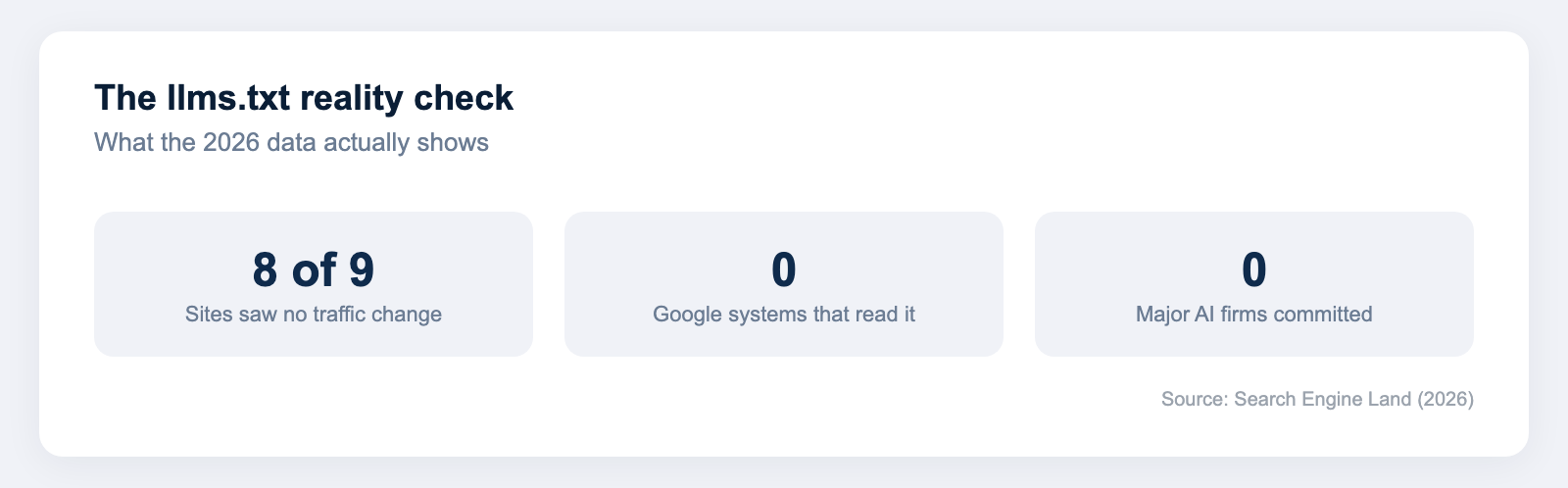
Could the one outlier mean something? Maybe - or it could be noise from unrelated changes during the same window. A single mover in nine, against a confirmed "we don't read it" from the largest engine, is not a trend. It's the kind of result you'd expect from a file with no reader.
| The llms.txt myth | What the data shows |
|---|---|
| "AI engines read it and cite you more." | No major AI company commits to reading it in production.[1] |
| "Google uses it for AI Overviews." | Google confirmed no Search system reads or acts on it.[1] |
| "Sites that add it get a traffic bump." | 8 of 9 tested sites saw no measurable change.[1] |
| "It's the new robots.txt - add it now." | robots.txt is an honored standard; llms.txt is an unadopted proposal. |
When IS llms.txt worth it?
There is one real use case, and it has nothing to do with marketing citations. llms.txt earns its keep in developer tooling. Coding assistants like Cursor and GitHub Copilot, and tools that let Claude fetch documentation, can use a clean llms.txt to pull your docs with far less token waste than parsing rendered HTML.[2]
So if you run a developer product with API docs or an SDK, an llms.txt that maps your documentation is genuinely useful - it makes your docs easier and cheaper for coding assistants to consume. That is a documentation-quality win, not a search-visibility one. Know which problem you're actually solving before you ship the file.
- Worth it: You publish developer docs and want coding assistants to fetch them efficiently.
- Worth it: You maintain an SDK or API reference and want clean, low-token context for tools.
- Not worth it: You want ChatGPT, Perplexity, or Gemini to cite your marketing or blog content.
- Not worth it: You expect a Google AI Overviews or organic traffic lift from the file alone.
SEO content that ranks, written and published for you
GetTraffic creates authority-building content clusters for your business. No writing, no freelancers, no content calendar. Agency-quality results at 91% less cost.
Start My Free TrialWhat you should do instead?
Spend the time on the levers that actually drive AI citations - because those are well documented. AI answer engines pull heavily from content that already ranks. Roughly half of sources cited in AI search rank in the top 10 organic results, and sites with a Domain Rating under 30 are rarely cited at all.[3] Classic rank and authority are still the price of entry.
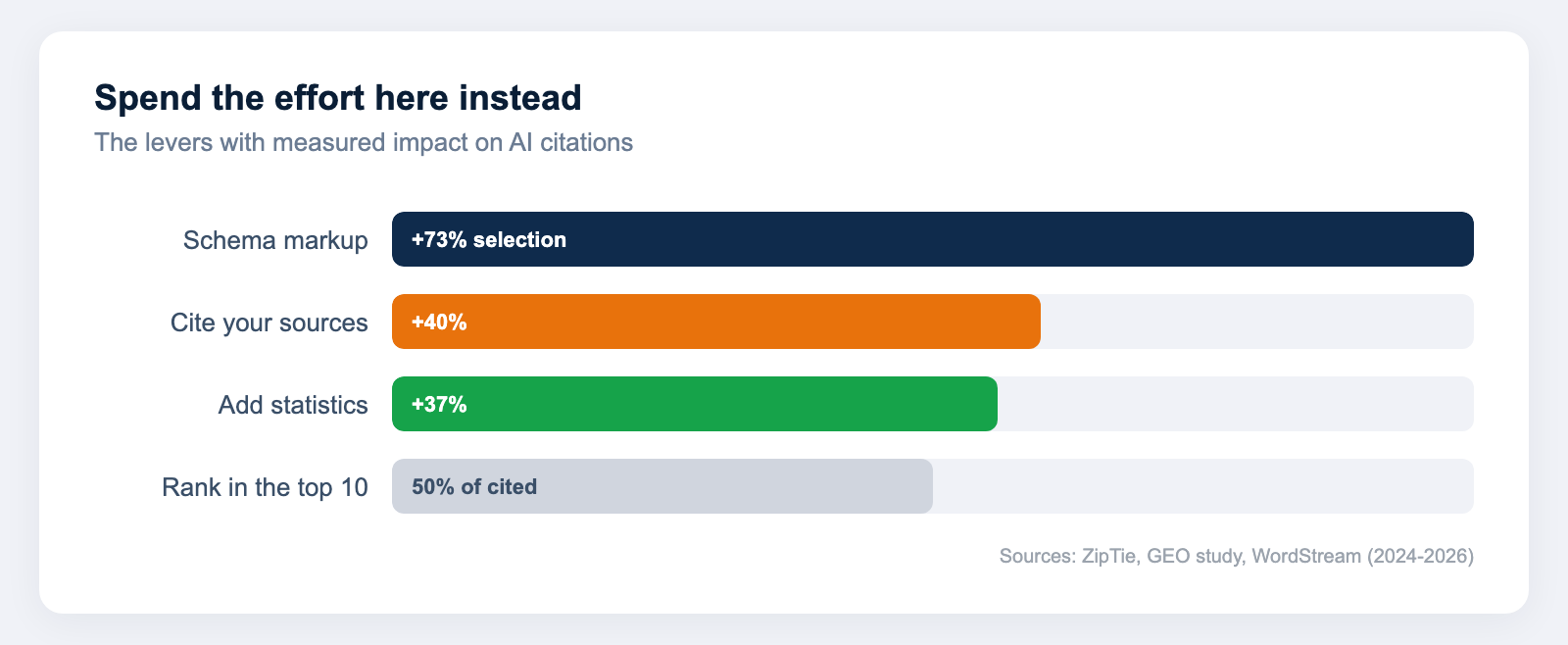
The scale of the surface is real, too: AI Overviews now appear in roughly 45% of searches, and top-10 ranking remains the strongest correlate of being pulled into them.[4] On the content side, a Princeton study on generative engine optimization found measurable lifts in citation visibility from concrete structural moves: citing sources raised visibility by up to 40%, adding statistics by 37%, and including quotations by 30%.[5]
| Skip this | Do this instead |
|---|---|
| Adding llms.txt for citations | Earn top-10 rankings - ~50% of AI citations rank top 10[3] |
| Waiting for a file to be read | Build domain authority - DR under 30 is rarely cited[3] |
| Generic, sourceless copy | Cite sources, add statistics and quotations[5] |
| Hoping engines find you | Add clean structure and schema so they can parse you |
This is the boring, durable work: structure, schema, and authority. It's also where GetTraffic puts its effort - building topical-authority clusters and clean structure that the engines actually reward, rather than shipping gimmicks that test to zero. For the full playbook, see our generative engine optimization guide. If your content isn't getting picked up, start with why AI isn't citing your content and the concrete steps to get cited by ChatGPT.
So is llms.txt a scam?
No - and that's an important distinction. llms.txt is a sincere, well-intentioned proposal that solves a real problem for developer tooling. It is not a scam. The problem is the marketing narrative bolted onto it: the claim that adding it lifts your AI citations. That claim is unsupported by every test and contradicted by Google directly.[1]
If you have ten minutes and a developer product, add it to your docs. If you have those ten minutes and a marketing goal, put them into ranking, authority, and structured, well-sourced content. That's not the exciting answer. It's the true one.
References
- Search Engine Land (2026). SEO in 2026: Higher standards, AI influence, and the web catching up. searchengineland.com
- Bluehost (2025). What is llms.txt? bluehost.com
- WordStream (2025). How to get cited by AI search. wordstream.com
- Search Engine Land (2025). How to optimize for AI Overviews. searchengineland.com
- Aggarwal et al. (2023). GEO: Generative Engine Optimization. arxiv.org
Frequently Asked Questions
Does llms.txt work for getting cited by AI?
Does Google read llms.txt?
When is llms.txt actually useful?
What should I do instead of adding llms.txt?
Is llms.txt a scam?
Get your business on page 1 of Google
Get your business found on Google - SEO content written and published automatically.
Start My Free Trial7-day free trial