Does AI Search Traffic Actually Convert? The 2026 Data

Table of Contents +
- Does AI search traffic convert better than organic?
- Why does AI traffic convert so well?
- Is the traffic volume even meaningful yet?
- Is AI search actually growing?
- Which AI platforms send the most converting traffic?
- How do I capture this traffic?
- How should a small DACH e-commerce store act on this?
- Is it worth investing now, or should I wait?
- References
AI search traffic converts at 3.76% vs 1.19% organic - a 216% lift, and 4-5x for the Washington Post. The 2026 data on whether AI traffic is worth it.
TL;DR: AI search traffic is still low volume but it converts far better than organic. One study put AI visitors at 3.76% conversion versus 1.19% for organic search - a 216% lift. The Washington Post reported AI-platform visitors subscribe at 4-5x the rate of traditional search visitors. Worth optimizing for now.
Every founder asks the same thing when AI referrals first show up in analytics: is this real traffic or vanity? The volume looks tiny next to Google. A handful of sessions from ChatGPT or Perplexity each day is easy to ignore, and most analytics dashboards still bucket those visits under direct or referral, so they barely register.
But raw sessions are the wrong number to judge. What matters is what those visitors do once they land. And on that measure, AI search traffic is some of the highest-quality traffic you can get. Here is what the 2026 data shows, why each number behaves the way it does, and what it means for where you spend your content budget.
Does AI search traffic convert better than organic?
Yes, by a wide margin. One analysis found AI-referred visitors convert at 3.76% against 1.19% for traditional organic search - a 216% improvement.[1] The Washington Post reported its AI-platform visitors subscribe at 4-5x the rate of visitors from traditional search.[1] The pattern is consistent: fewer clicks, but each one is worth more.
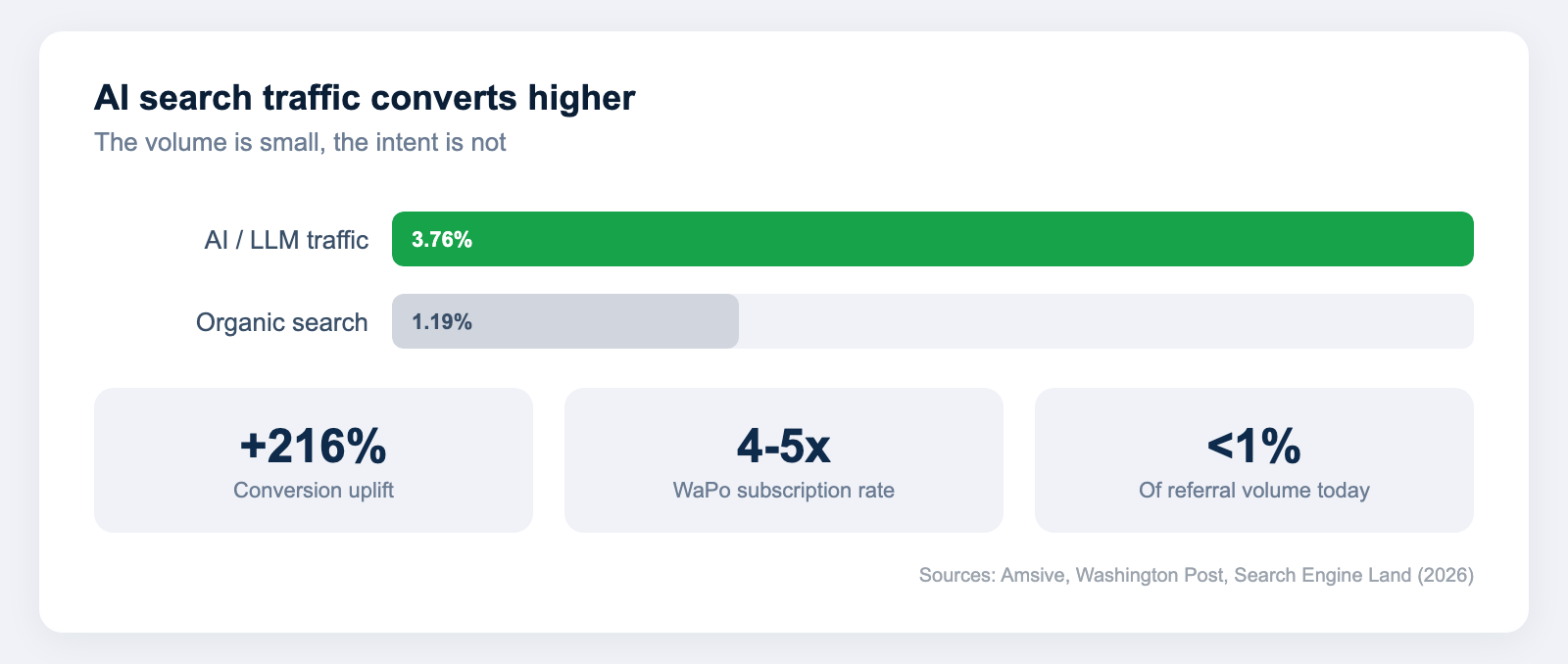
| Source | Conversion behavior | Versus traditional search |
|---|---|---|
| Traditional organic search | 1.19% conversion rate | Baseline |
| AI / LLM referral | 3.76% conversion rate | +216% |
| Washington Post (AI platforms) | Subscribe at 4-5x the rate | 4-5x |
Notice that the two figures come from different businesses and different conversion events. The 3.76% is a purchase or signup rate; the Washington Post number is a paid subscription, a much higher-commitment action. That two separate organizations, measuring two different goals, both land on a 3-5x advantage is what makes the signal credible. It is not one outlier dashboard - it is the same behavior showing up in unrelated data sets.
GetTraffic writes and publishes SEO content automatically - articles that build authority and drive organic traffic - start your free trial.
Why does AI traffic convert so well?
Because the visitor arrives pre-qualified. An AI answer has already done the research, compared options, and named you as part of the recommendation. By the time someone clicks through, they are not browsing - they are validating a decision the model already helped them make. That collapses the funnel. The top-of-funnel education happens inside the chat, so the click lands much closer to intent.
Three things drive the quality gap:
- Intent is downstream of an answer. The user got a synthesized response and clicked to confirm or buy, not to keep searching. The click that follows a shortlist is the last step before a purchase, not the first step of research.
- You arrive recommended, not ranked. Being cited as a source carries more trust than being result number four on a page of ten. The model frames you as the answer, so the visitor lands already half-sold rather than skeptical.
- Less comparison shopping. The model narrowed the field before the click, so fewer visitors bounce to weigh five alternatives in five other tabs. The decision fatigue that erodes organic conversion happened inside the chat instead of on your site.
This is also why the gap is unlikely to close as volume grows. As long as AI assistants do the comparison work before the click, the visitors they send keep arriving further down the funnel than a cold Google searcher. The advantage is structural, not a quirk of early adopters.
Is the traffic volume even meaningful yet?
Honestly, not in raw numbers. AI referral traffic is still under 1% of total referrals even for large publishers like Reuters and The Guardian.[1] If you judge AI search on volume alone, you will dismiss it. The point is that the value is in intent and quality, not headcount. A small stream of buyers beats a flood of researchers who never convert.
Run the arithmetic and the picture flips. If 1,000 organic visitors convert at 1.19%, that is about 12 conversions. Just 200 AI visitors at 3.76% is roughly 8 conversions - two-thirds of the result from one-fifth of the traffic. The cost-per-conversion on the AI stream is far lower, which is exactly why a channel that looks negligible in a sessions report can be one of your most efficient.
For a DACH e-commerce store, that trade is attractive. You do not need ten thousand AI sessions. You need the few hundred that arrive ready to buy, and you need to be the brand the model names when a shopper asks for a recommendation in your category.
Is AI search actually growing?
Yes, and the shift is structural. Gartner projects traditional search engine volume will drop 25% by 2026 as users move queries into AI assistants.[2] Inside Google itself, AI Mode produces roughly 93% zero-click sessions - the answer is delivered without anyone leaving the page.[2] The behavior is not a fad; it is becoming the default way people find things.
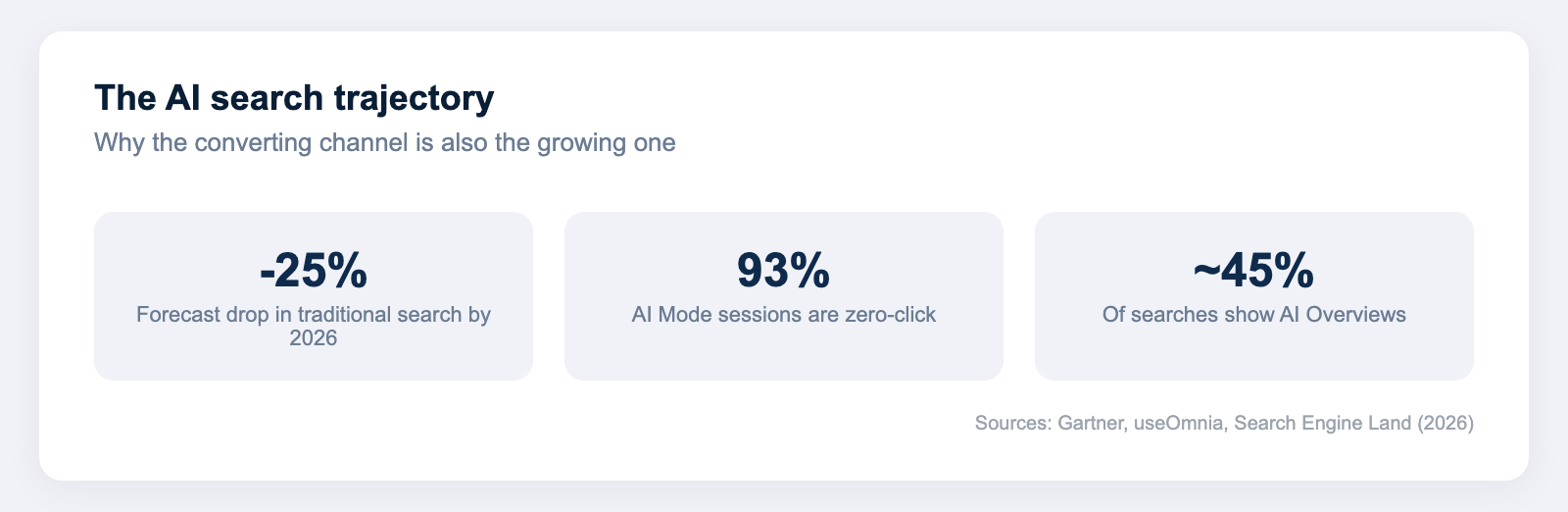
The 25% drop matters because search demand is not shrinking - it is relocating into assistants that answer in place. The 93% zero-click figure is the mechanism: when the answer is on the page, the click never happens. The slice that does still click out is, almost by definition, the higher-intent slice that wanted more than the summary.
This also reshapes classic SEO. AI Overviews now appear in around 45% of searches and can cut clicks to your site by up to 58%.[3] So the traffic you lose to zero-click is partly being replaced by a smaller, higher-converting AI referral stream. The question is whether you are positioned to capture it. For the strategy behind that shift, see our guide to GEO vs SEO and how to rank in Google AI Overviews.
Which AI platforms send the most converting traffic?
The strongest referral streams come from the assistants that link out rather than answer in place. Perplexity and ChatGPT cite sources prominently and send users to those pages, while Google AI Mode keeps roughly 93% of sessions zero-click.[2] The platforms that show their sources are the ones that send buyers.
A platform that surfaces citations inline gives the user a reason to click through - to verify a spec, read reviews, or check stock - and those are exactly the high-intent visits that convert. A platform that answers fully in place sends fewer clicks, but the ones it does send are the users the summary could not satisfy. In both cases the visitors are pre-filtered, which is why the conversion rate holds up across sources.[1] The lesson is not to chase one platform but to be citable everywhere, since the same structured content earns mentions across all of them.
SEO content that ranks, written and published for you
GetTraffic creates authority-building content clusters for your business. No writing, no freelancers, no content calendar. Agency-quality results at 91% less cost.
Start My Free TrialHow do I capture this traffic?
You get cited by being the clearest, best-structured answer in your topic. AI models pull from content that is specific, well-organized, and easy to extract. That means direct answers up top, structured data, clear headings, and depth across a whole topic rather than one thin post. This is the core of generative engine optimization.
Concretely, prioritize:
- Topical authority, not one-off posts. Models cite sources that cover a subject comprehensively. A cluster of connected articles beats scattered pages.
- Answer-first structure. Lead each section with a 40-75 word direct answer the model can lift verbatim.
- Cited, verifiable claims. Numbers with sources get quoted; vague marketing copy does not.
- FAQ and schema markup. Structured Q&A is the format AI answer engines reach for first, and it is what feeds AI Overviews.[3]
Producing this at the scale and consistency models reward is the hard part. GetTraffic builds industry-specific topical-authority clusters - the cited, structured content that captures high-intent AI traffic - and auto-publishes to your CMS, so you are not writing 10 deeply researched articles a month by hand. You can also measure your AI search visibility to see where you already get cited.
How should a small DACH e-commerce store act on this?
Start by being the answer for your specific product questions, in German, before larger competitors do. A small store cannot outspend a marketplace, but it can publish deeper, clearer answers about its narrow category - sizing, materials, use cases, comparisons - and earn the citation a generic listing never will. Win the niche questions first; that is where intent and conversion are highest.
Here is a practical sequence to capture high-intent AI traffic:
- Segment AI referrals in analytics. Build a channel or filter for ChatGPT, Perplexity, Gemini and other assistant referrers so you can see real conversion rate by source rather than guessing.
- List the questions buyers actually ask. Pull them from support tickets, on-site search, and the queries that already bring AI clicks. These are the prompts you want to be the answer to.
- Publish answer-first content for each. Lead every page or section with a 40-75 word direct answer, then add the depth - specs, comparisons, real numbers - that earns the citation.
- Add FAQ and product schema. Structured Q&A and product markup are the formats AI engines reach for first.[3]
- Build a cluster, not a page. Connect related articles so models read you as a comprehensive source on the category, not a one-off post.
- Re-measure monthly. Track which pages get cited and which AI sources convert, then double down on what works.
Is it worth investing now, or should I wait?
Invest now. Two forces compound in your favor. First, early-mover advantage: the brands models cite today build a track record that newer entrants struggle to displace. Second, content compounds - a topical cluster you publish this quarter keeps earning citations and conversions for years. Waiting until AI traffic is a large share of your sessions means competing for citations after the slots are taken.
The math is simple for a DACH store. AI referral volume is small but converts at 3-5x the rate of organic.[1] If you can win those citations cheaply while the field is open, the ROI is asymmetric. The cost of waiting is not zero - it is the citations your competitors lock in while you watch, plus the organic clicks the 25% search decline keeps eroding.[2] Compare the build-it-yourself options on our AI tools comparison, or see what an engine costs on our pricing page.
References
- Search Engine Land (2025). The SEO-GEO gap: AI search traffic vs organic traffic. searchengineland.com
- Omnia (2025). AI search monitoring tools. useomnia.com
- Search Engine Land (2025). How to optimize for AI Overviews. searchengineland.com
Frequently Asked Questions
Does AI search traffic convert better than organic search?
Why does AI search traffic convert so well?
Is AI search traffic volume meaningful yet?
Is AI search growing fast enough to matter?
How do I get my site cited by AI search engines?
Should I invest in AI search optimization now or wait?
Get your business on page 1 of Google
Get your business found on Google - SEO content written and published automatically.
Start My Free Trial7-day free trial